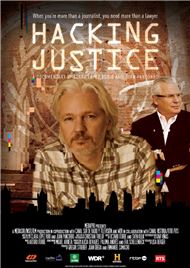
HACKING JUSTICE - Film Screening
Infos
Deutschland, Spanien, Schweiz, Belgien 2021
Regie: Clara López Rubio, Juan Pancorbo
Drehbuch: Clara López Rubio, Juan Pancorbo
Darsteller: Julian Assange, Sarah Harrison
Kamera: Christian Trieloff
Schnitt: Octavio Iturbe
90 min
For their documentary film “Hacking Justice” filmmakers Clara López Rubio and Juan Pancorbo followed the legal prosecution of the Wikileaks founder for nine years and gained exclusive access to his legal team led by former Spanish judge Baltasar Garzón. The film covers the period up to 2021; The directors will be available for a Q&A after the screening to discuss the period leading up to his release.
© Disruption Network Lab
© Disruption Network Lab
————
Als Julian Assange, Journalist und Gründer der Whistleblower-Plattform Wikileaks, am 24.Juni 2024 als freier Mensch den Boden seines Heimatlands Australien betrat, endete für ihn eine Gefangenschaft von mehr als 13 Jahren.
Mit der Pressefreiheit, für die er den Kampf aufgenommen hatte, ging es aber weiter sehr stark bergab. Allein Im Israel-Palästina-Krieg starben (und sterben bis heute) Hunderte von Reportern, Dutzende davon in Presseschutzkleidung, durch gezielte Tötung (1).
Hinzu kommt die strafrechtliche Verfolgung: Zurzeit werden z.B. Journalisten im Vereinigten Königreich, die über den Krieg in Israel und Palästina abweichend von der offiziellen Linie berichten, mit dem Terrorism Act, dem Terrorismus-Gesetz bedroht: Ihre Handys und Computer werden beschlagnahmt und durch Prozessandrohungen ihre Arbeit auf unbestimmte Zeit verhindert.
In mehreren Ländern der EU werden Journalisten als russische „Agenten der Desinformation“ gebrandmarkt und ihre Konten eingefroren (2).
Bei Julian Assange, dessen Veröffentlichungen Kriegsverbrechen der USA in Afghanistan und Irak enthüllten, war es das US-Amerikanische Spionage-Gesetz, das gegen ihn in Stellung gebracht wurde.
Die unsichtbaren Helden im Kampf gegen diesen Krieg gegen den Journalismus sind die Anwälte. Anwälte sowie auch Berichterstatter der UNO analysieren die Möglichkeiten der Justiz, erkunden Präzedenzfälle für Whistleblowing und Spielarten des Journalismus, um die Gesetzestreue ihres Mandanten und den Einklang mit den Grundrechten in der Allgemeinen Menschenrechtserklärung zu belegen. Wikileaks war seiner Zeit voraus, diesen Sprung mussten auch die Anwälte nachvollziehen können und in der Lage sein, Gerichtsbarkeit, Justiz, für die neuen Herausforderungen dienstbar zu machen, "Justiz zu hacken".
Der spanische Anwalt Baltasar Garzón, dem es als Richter gelungen war, den Diktator Pinochet wegen Verbrechen gegen die Menschlichkeit anzuklagen und 16 Monate in London festzusetzen, war der Anwalt, der diese Aufgabe übernahm und fortan, seit 2010, die Arbeit der vielen Anwälte für Julian Assange koordinierte.
Die beiden Filmemacher Clara López Rubio und Juan Pancorbo haben es geschafft, das Vertrauen seines Teams zu gewinnen und über 9 (!) Jahre dabei zu sein, wie die Anwälte die Lage von Assange ausloten und wie eine Freilassung möglich gemacht werden könnte.
Der Film deckt die Zeit bis 2021 ab; für die Zeit bis zur Freilassung stehen die Regisseure im Q&A nach der Vorstellung zur Verfügung.
(1) https://taz.de/Journalismus-im-Gazastreifen/!6107699/
https://www.craigmurray.org.uk/wp/wp-content/uploads/2025/02/AL-GBR-15-2024-Craig-Murray-et-al-UN-comm-to-UK-with-cover.pdf
(2) https://free-baud.org/
https://walliser-zeitung.ch/jaques-baud-sanktionen/
https://michael-von-der-schulenburg.com/legal-opinion/
https://thetransnational.substack.com/p/jacques-baud-and-the-eunato-censorship
_________________________________
https://www.hebbel-am-ufer.de/en/programme/festivals-projects/exposing-crimes-is-not-a-crime
This event is a cooperation between Assange Support Berlin & the director Clara López, ACUDkino and Disruption Network Labs Symposium “Exposing Crimes is Not a Crime: The Real-World Consequences of WikiLeaks” (funded by Hauptstadtkulturfond in cooperation with the WAU Holland Stiftung and HAU Hebbel am Ufer).